Universal Diffusion Models for Implied Volatility Surfaces: Learning Shared Dynamics Across Stocks
A universal diffusion model trained on pooled data from 50 stocks learns to jointly generate implied volatility surface changes and stock returns, extrapolating well to unseen stocks.
Featured in No. 132 on 25 Sep 2026 · 3 days after release · 0 citations today
- Released
- 22 Sep 2026
- First featured
- No. 132 · 25 Sep 2026
- Citations (Semantic Scholar)
- 0
- Influential citations
- 0
- Published in
- Not yet, as far as Semantic Scholar knows
- Fanfare
- 3 of 5
- Identifier
- arXiv:2609.22893
- Authors
- Mingzhi Yang et al.
Abstract
From arXiv (CC0).
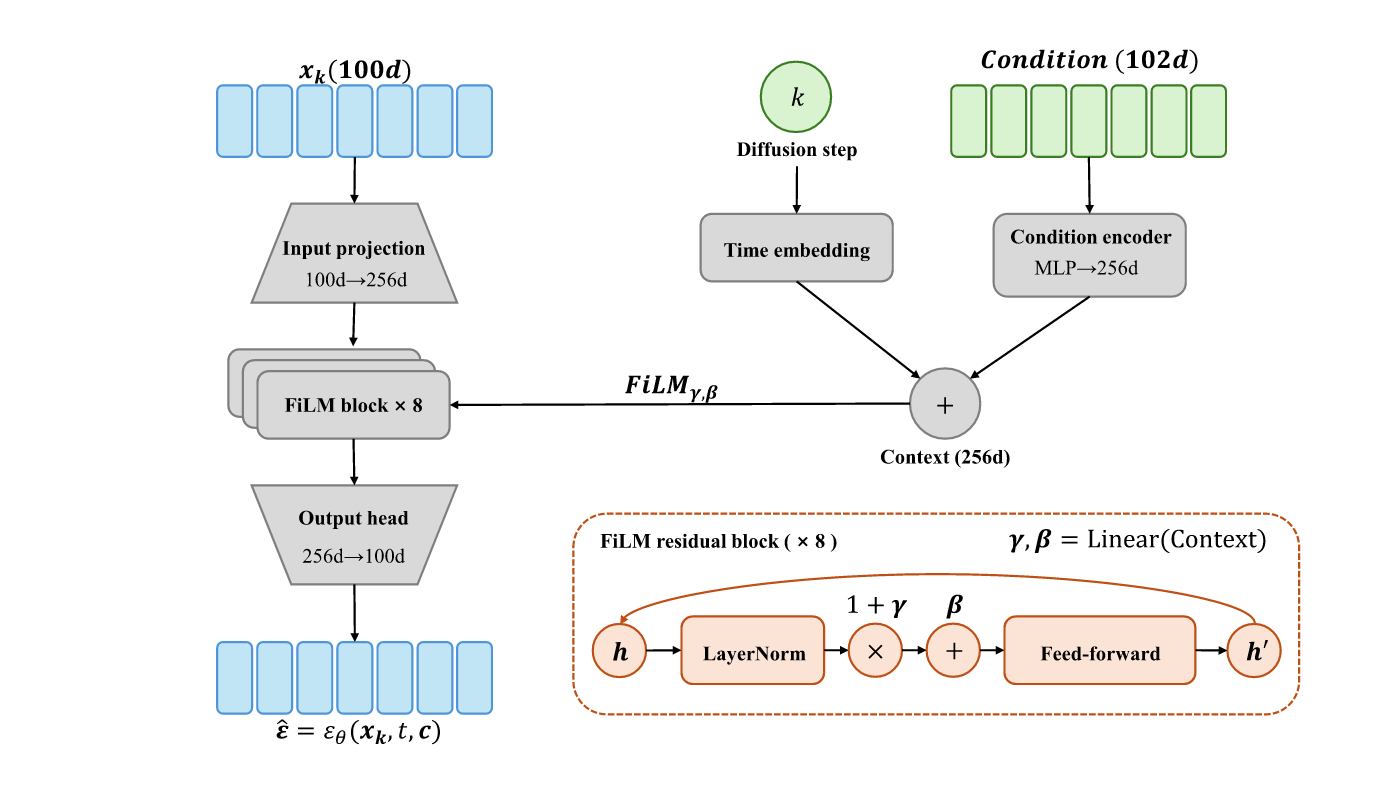
Modeling the dynamics of option implied volatility surface (IVS) is crucial for pricing, hedging, and risk-managing option portfolios. We develop a universal conditional diffusion model that learns to jointly generate next-day IVS increments and the underlying stock's returns. The model is trained on pooled data from 50 stocks and evaluated on a test set comprising 50 in-sample stocks and 50 out-of-sample stocks excluded from training. The training objective is primarily the minimization of MSE, with the variants that jointly impose surface smoothness, and that penalize the presence of static-arbitrage, which are all economically meaningful constraints. Across in-sample and out-of-sample stocks, our diffusion model outperforms the VolGAN benchmark in reducing arbitrage violations, improving stock risk prediction, and aligning explained variance ratios by the first three principal components. The fact that the model extrapolates well to stocks that are excluded from training indicates that the learned dynamics can be shared across stocks. These findings support a universal conditional diffusion as a credible framework for multi-stock implied volatility surface scenario generation.
Citations and venue from Semantic Scholar (ODC-BY), refreshed weekly. Summary: Quant Letter (CC BY 4.0).