arXivLLMs & Text
FinRankGRPO: Optimizing LLMs for Listwise Financial Asset Ranking via Group Relative Policy Optimization
Develops a two-stage framework that fine-tunes language models for listwise asset ranking using Spearman rank correlation rewards, achieving a Sharpe ratio of 0.636 on asset allocation.
Featured in No. 132 on 25 Sep 2026 · 3 days after release · 0 citations today
- Released
- 22 Sep 2026
- First featured
- No. 132 · 25 Sep 2026
- Citations (Semantic Scholar)
- 0
- Influential citations
- 0
- Published in
- Not yet, as far as Semantic Scholar knows
- Fanfare
- 2 of 5
- Identifier
- arXiv:2609.24175
- Authors
- Ningyuan Deng et al.
Abstract
From arXiv (CC0).
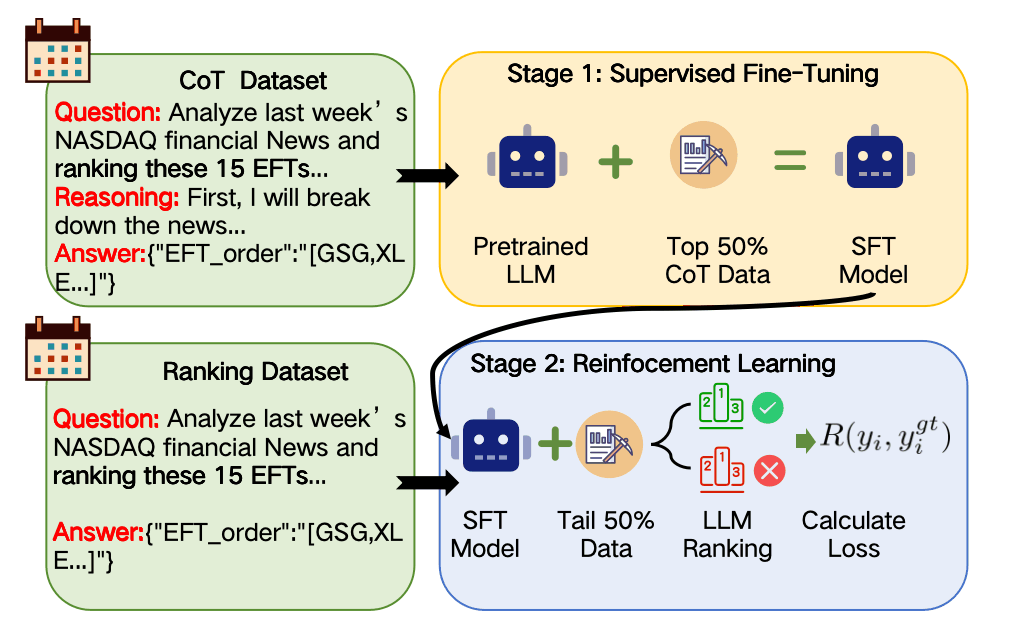
While Large Language Models (LLMs) excel at understanding unstructured financial contexts, their direct use in portfolio optimization is limited by a mismatch between next-token prediction and the listwise ranking objectives required for asset allocation. They also struggle with precise numerical forecasting, leading to instability and arithmetic hallucinations. To bridge this gap, we propose FinRankGRPO, a framework that shifts LLM based portfolio construction from direct numerical prediction to listwise ranking of financial assets. We introduce a two-stage training process, supervised finetuning on Chain-of-Thought reasoning data, followed by our Financial Asset Ranking via Group Relative Policy Optimization with a Spearman rank correlation reward that aligns generated asset rankings with ground truth market orderings. The second stage uses a novel Spearman rank correlation reward to explicitly align the model's generative preferences with ground truth market orderings. Experimental results show that FinRankGRPO outperforms traditional quantitative and state-of-the-art commercial models, achieving a Sharpe ratio of 0.636 and a Spearman correlation of 0.023.
Citations and venue from Semantic Scholar (ODC-BY), refreshed weekly. Summary: Quant Letter (CC BY 4.0).