The Critical Line Algorithm and the Constrained LASSO: One Curve, Two Literatures
Shows that mean-variance portfolio selection and the constrained LASSO trace identical piecewise-linear solution paths, mapping their parametrizations exactly.
Featured in No. 132 on 25 Sep 2026 · 2 days after release · 0 citations today
- Released
- 23 Sep 2026
- First featured
- No. 132 · 25 Sep 2026
- Citations (Semantic Scholar)
- 0
- Influential citations
- 0
- Published in
- Not yet, as far as Semantic Scholar knows
- Fanfare
- 2 of 5
- Identifier
- arXiv:2609.25704
- Authors
- Thomas Schmelzer and Trevor Hastie
Abstract
From arXiv (CC0).
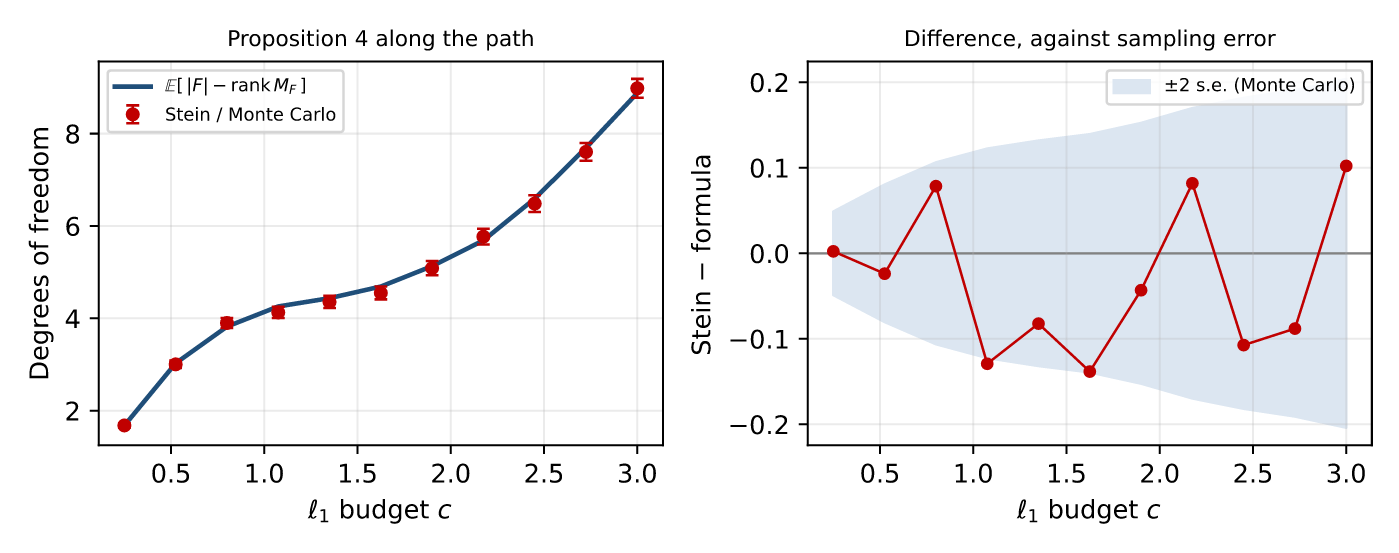
Many statistical procedures compute an entire solution path rather than a single estimator. For one class the path is piecewise linear, traced corner to corner by an active-set homotopy. Two of its members coincide exactly: under $Σ=X^\top X$ and $μ=X^\top y$ the gross-exposure-constrained mean--variance program and the constrained LASSO trace the same piecewise-linear curve, and they keep doing so under arbitrary linear equality and inequality constraints. Which parameter is swept, a leverage budget or a return tilt, is not a choice the curve notices: under a homogeneous mandate the two sweeps differ by a scalar. A mandate that holds the portfolio invested costs a radial rescaling instead, and the efficient frontier is that curve rescaled; its corners pass unnoticed because the frontier is continuously differentiable where they fall. We give the map between the two parametrisations and the single way it degenerates. That mean--variance selection and the LASSO instantiate one parametric quadratic program is prior art (Gärtner, Jaggi and Maria, 2012). The Critical Line Algorithm itself lies off that route, and the correspondence established here is new. The identity is one of curves, not of statistical experiments. The map between the parametrisations is computed from the data, so the geometry of the path transfers while quantities averaged over the response do not. We cross that boundary deliberately and give the degrees of freedom of the constrained fit under arbitrary linear constraints. In the long-only, fully invested case it is the expected number of holdings away from a bound, less one.
Citations and venue from Semantic Scholar (ODC-BY), refreshed weekly. Summary: Quant Letter (CC BY 4.0).