Learning to Detect Symbolic Failure: Machine Learning and the Limits of Black-Scholes
Tree-based machine learning outperforms neural networks at detecting systematic option-pricing deviations from Black-Scholes using 2.6 million real contracts, with domain-expert features crucial.
Featured in No. 132 on 25 Sep 2026 · 1 day after release · 0 citations today
- Released
- 24 Sep 2026
- First featured
- No. 132 · 25 Sep 2026
- Citations (Semantic Scholar)
- 0
- Influential citations
- 0
- Published in
- Not yet, as far as Semantic Scholar knows
- Fanfare
- 2 of 5
- Identifier
- arXiv:2609.27764
- Authors
- Juli Huang et al.
Abstract
From arXiv (CC0).
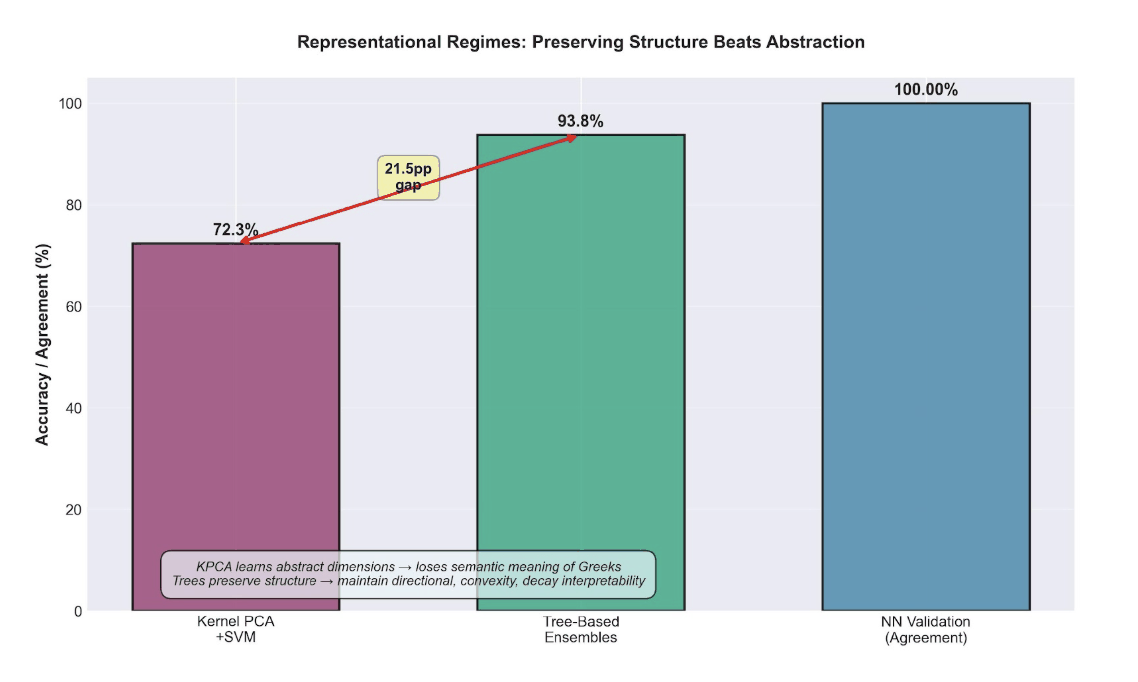
We treat options pricing as a representation problem: can machine learning detect systematic deviations from Black-Scholes using 2.6M real option contracts? We compare three regimes: learned abstract embeddings (Kernel PCA), preserved domain structure (tree-based ensembles), and neural network validation. Tree-based methods outperform kernel dimensionality reduction by 21.5 percentage points (93.8% vs 72.3%), and domain-expert features (Greeks, moneyness) outperform engineered features. NN-based and BS-based deviation labels agree 99.9974% of the time, suggesting deviations reflect market structure rather than model artifact. We conclude that in domains with expert-designed symbolic features, preserving structure beats learning abstractions. We make no claim of exploitable mispricings.
Citations and venue from Semantic Scholar (ODC-BY), refreshed weekly. Summary: Quant Letter (CC BY 4.0).