arXivML & AI Methods
Diversification Across Predictors: Heterogeneous Ensemble Learning for Cross-Sectional Return Prediction
Combining linear and nonlinear predictors as specialists improves rank IC by over 13% on daily Chinese stock returns versus neural networks alone.
Featured in No. 139 on 13 Nov 2026 · 3 days after release · 0 citations today · published in Proceedings of the 7th ACM International Conference on AI in Finance
- Released
- 10 Nov 2026
- First featured
- No. 139 · 13 Nov 2026
- Citations (Semantic Scholar)
- 0
- Influential citations
- 0
- Published in
- Proceedings of the 7th ACM International Conference on AI in Finance
- Fanfare
- 3 of 5
- Identifier
- arXiv:2611.12389
- Authors
- Danning Li
Abstract
From arXiv (CC0).
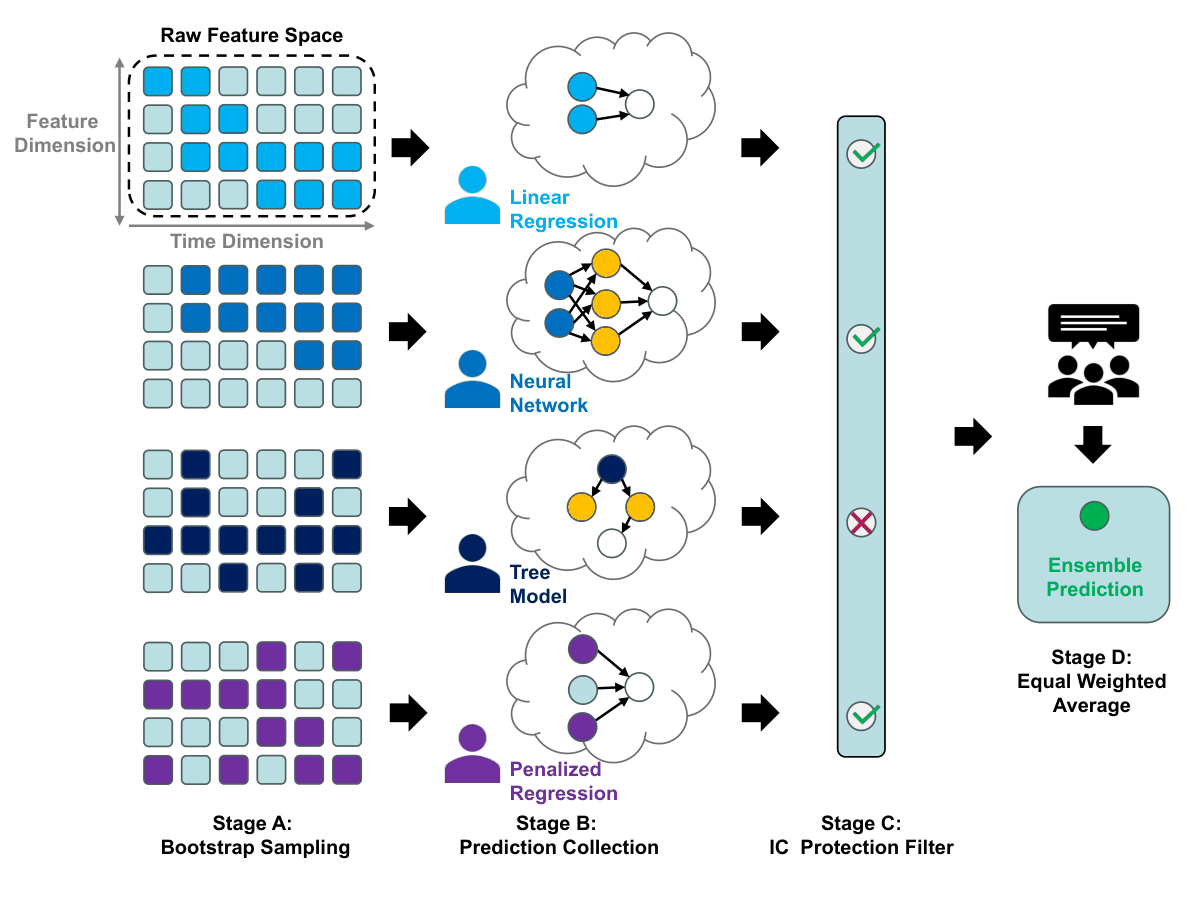
Cross-sectional stock return prediction remains challenging due to extremely low signal-to-noise ratios, high-dimensional factor spaces, and non-stationary predictor effectiveness. Individual model classes exhibit complementary failure modes in this regime: neural networks overfit noise due to high variance, while linear models underfit nonlinear structure due to high bias. We propose a heterogeneous ensemble framework that extends the financial principle of diversification to the predictor level. Through a bagging procedure combining linear predictors with nonlinear predictors, each model functions as a distinct specialist whose prediction errors exhibit low cross-covariance, enabling error cancellation upon aggregation. We formalize this mechanism via bias-variance-covariance decomposition, establishing an exact mathematical correspondence between portfolio diversification and predictor aggregation. On CSI300 daily-frequency Alpha158 factor datasets, the proposed ensemble achieves a Rank IC improvement exceeding 13\% over standalone neural networks and surpasses tree-based state-of-the-art methods including XGBoost and Double Ensemble, as measured by both predictive accuracy and portfolio-based evaluation metrics.
Citations and venue from Semantic Scholar (ODC-BY), refreshed weekly. Summary: Quant Letter (CC BY 4.0).